Konzerthaus Berlin - Werner-Otto-Saal
Zafraan Ensemble
Concert
Gendarmenmarkt, 10117 Berlin
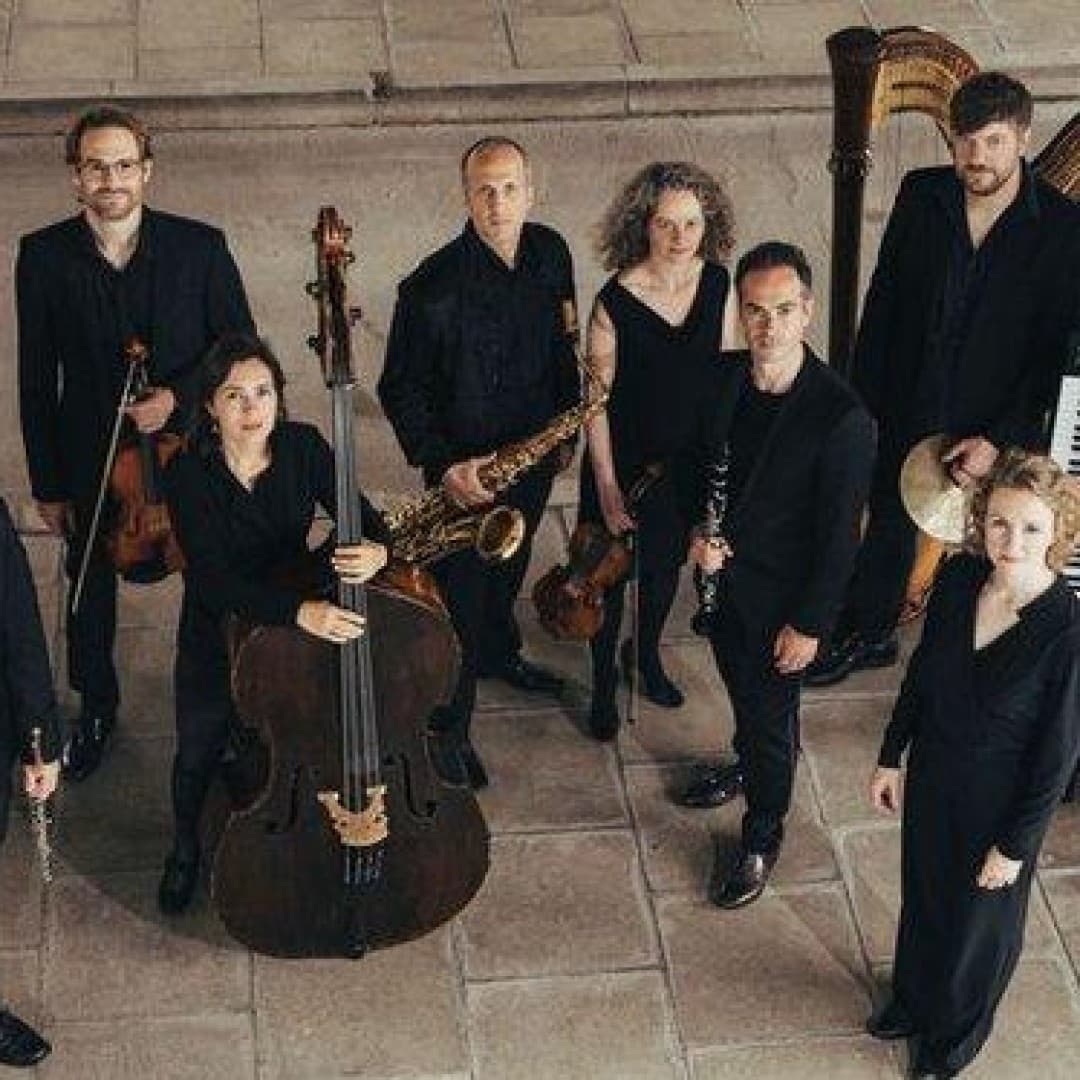
© Anton Tal
Concert program
Keiko Devaux
„Arras“ (2020)
Eres Holz
„Kataklothes“ (2015)
INTERMISSION
Ajtony Csaba
„Taajuu“ (UA)
Michaela Catranis
„Inside the Veins of a Petal“ (2025)
„Arras“ (2020)
Eres Holz
„Kataklothes“ (2015)
INTERMISSION
Ajtony Csaba
„Taajuu“ (UA)
Michaela Catranis
„Inside the Veins of a Petal“ (2025)
Description
“Man did not weave the web of life; he is merely a strand in it. Whatever he does to the web, he does to himself.” This quote, attributed to Chief Si'ahl, describes on a larger scale processes that can be seen both in the compositions and in the chamber music performance itself. A work is never created without its history.
In “Arras,” Keiko Devaux draws on sound influences that represent the professions of her ancestors: the sound of the wind sweeping across the farm fields, the sound of a mechanical loom, and the musical traditions (French chansons and American-Japanese folk music) with which her family members expressed their identity.
The spinning of the threads of life, a recurring motif in Indo-European mythology, forms the basis of Eres Holz's composition “Kataklothes”: the figurations of the 10 instruments are woven into a progressive “chorale” that becomes increasingly rhythmic, complex, and playful.
Csaba Ajtony's new work “Taajuu” (Haida for “wind”) expands the focus on the visual components of ensemble playing: the interconnection of coordinative gestures and sound-producing movements forms the starting point for the jointly developed composition.
Supported by the Azrieli Foundation
In “Arras,” Keiko Devaux draws on sound influences that represent the professions of her ancestors: the sound of the wind sweeping across the farm fields, the sound of a mechanical loom, and the musical traditions (French chansons and American-Japanese folk music) with which her family members expressed their identity.
The spinning of the threads of life, a recurring motif in Indo-European mythology, forms the basis of Eres Holz's composition “Kataklothes”: the figurations of the 10 instruments are woven into a progressive “chorale” that becomes increasingly rhythmic, complex, and playful.
Csaba Ajtony's new work “Taajuu” (Haida for “wind”) expands the focus on the visual components of ensemble playing: the interconnection of coordinative gestures and sound-producing movements forms the starting point for the jointly developed composition.
Supported by the Azrieli Foundation
Cast
Miguel Pérez Iñesta
Conductor
Zafraan Ensemble
Dates
Konzerthaus Berlin - Werner-Otto-Saal
Gendarmenmarkt, 10117 Berlin
To enable Google Maps please accept functional cookies.